The Impact of Cryptocurrency Mining on Local Communities
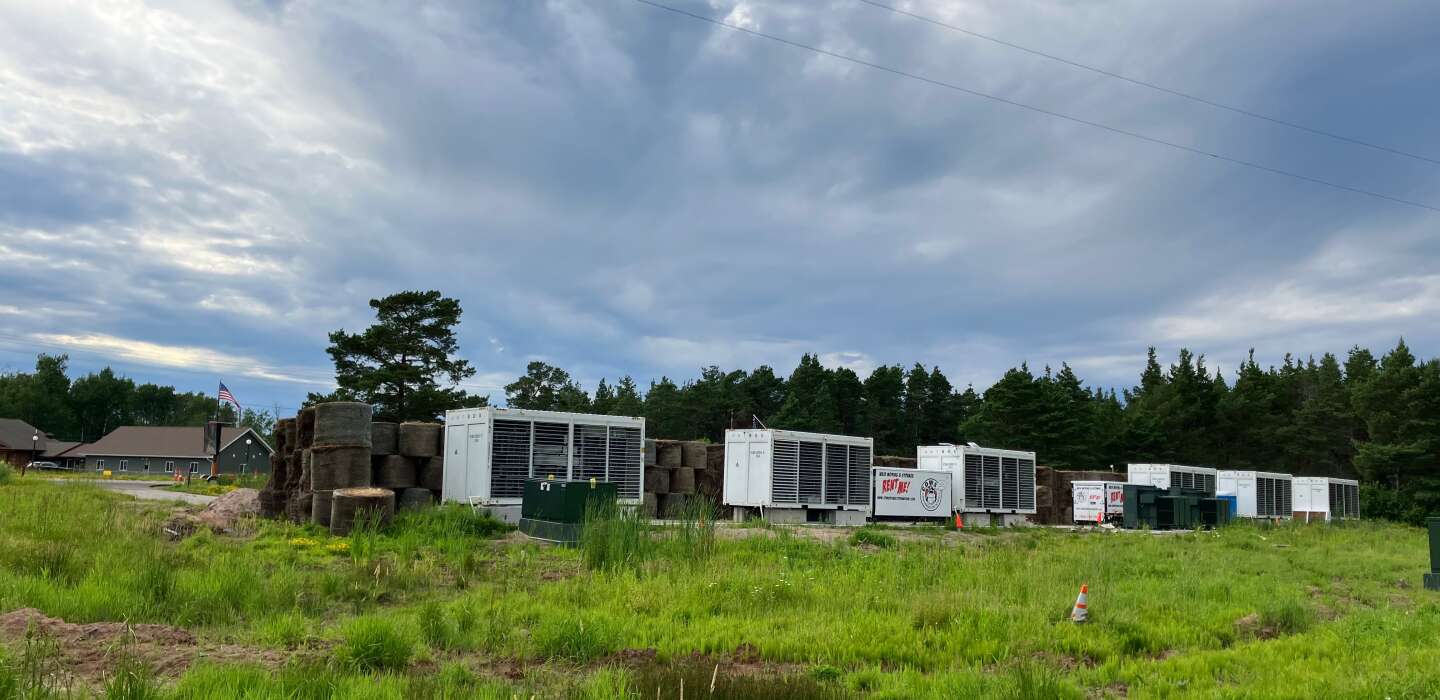
(TNS) — Just south of Sault Ste. Marie on Mackinac Trail lies a cryptocurrency mining operation run by Odessa Partners LLC. This facility is garnering attention not only for its operations but for the environmental and social impacts it is having on the surrounding community. Initially, the sound emitted from the mining operation registered at 75 decibels—comparable to a running vacuum cleaner—at the edge of Lake Superior Academy’s property, according to Superintendent Susie Schlehuber.
At the school’s front door, the noise level measured at 65 decibels, which is similar to that of a washing machine. The high-pitched metallic whine of the operation began in March and has been somewhat mitigated by the addition of hay bales around the site. Despite this, the noise persists virtually nonstop, as noted by Schlehuber: “It’s 24 hours a day, seven days a week. It never stops.”
The school, which has an environmental focus and caters to around 100 students, prioritizes outdoor activities and learning experiences. Therefore, the constant noise has been particularly disruptive. Schlehuber mentions that due to the noise pollution, they have ceased outdoor lessons, stopped opening windows, and even put plans for new classrooms on ice.
About Odessa Partners LLC
The operation is owned by Odessa Partners LLC—registered in Boca Raton, Florida. Legal documents indicate that this company comprises two other entities: Wyoming Partners Irrevocable Statutory Trust and Valletta Corp, LLC, both with ties to Michael Carbonara, the CEO of financial technology firm Ibanera. This company identifies itself as a “fintech enablement platform” focused on cross-border payments. Carbonara is also responsible for applying for the building permit for the cryptocurrency mining operation. However, he and his legal team have not responded to requests for comments.
Following a court-ordered temporary halt to operations last month, Odessa Partners claimed it was incurring losses exceeding $15,000 per day. Interestingly, before the lawsuit was filed, they undertook actions to reduce noise pollution by placing hay bales in front of their machines. Legal motions further pointed out that the school’s property lies adjacent to Interstate 75, arguing that the noise generated was still less than that typically caused by traffic on the interstate.
Schlehuber contends that there is a significant difference between the occasional loud noise of passing trucks and the relentless sound produced by the mining operation. Having tried to engage meaningfully with Odessa Partners since March to find a resolution, she emphasizes that the lack of progress necessitated more formal action.
Understanding Cryptocurrency Mining
At its core, cryptocurrency mining involves using substantial computational power to solve complex mathematical problems, which help verify and record transactions on a public ledger—a blockchain. Unlike traditional forms of currency, cryptocurrencies are not backed by state or governmental institutions, making this verification process critical for maintaining the integrity of the system.
For miners, the task is to assign unique digital fingerprints to unverified transactions in the blockchain. This is inherently a game of chance; miners’ computers attempt to produce a specific sequence of numbers based on cryptographic algorithms, yielding random results. To put it in perspective, it is akin to attempting to roll double sixes 1,000 times consecutively. The only viable way to increase one’s odds of success is through continuous attempts.
Whenever miners succeed, they are rewarded with newly minted cryptocurrency alongside a share of transaction fees. However, the energy consumption for this process is significant—mining a single Bitcoin consumes as much energy as an average U.S. household would use in 39 days, according to the Bitcoin Energy Consumption Index.
The Attraction to Northern Michigan
The Sault Ste. Marie area is attractive for such operations for several reasons. Cold climates mitigate cooling costs, making it efficient to manage the heat generated by the mining rigs. Kevin Shaw, CEO of OOM Technologies, which operates a similar facility not far from Odessa Partners, stated that natural airflow is the most efficient cooling method. In addition, local electrical utilities like Cloverland Electric Cooperative are actively looking to partner with operations that require a consistent and high volume of energy.
In their pursuit of a stable customer, Cloverland approached the Lake Superior Academy last fall for an easement through their property. However, the school board received vague responses to their inquiries about the nature of the project, resulting in a decision to reject the proposal. Interestingly, it later surfaced that Cloverland had reached out to Odessa Partners about utilizing the property.
When asked whether the electrical cooperative had actively directed Odessa Partners to the site, a spokesperson forwarded an FAQ that did not clarify their involvement but reiterated the benefits of high-volume energy users for grid stability and revenue generation.
The controversy sparked by the cryptocurrency mining operation has prompted local officials, like Dafter Township Supervisor Bob Brown, to consider implementing clearer regulations for data centers to better balance the needs of businesses and community quality of life.
Looking Forward
For Schlehuber, the choice of Odessa Partners to operate so close to an elementary school raises eyebrows. “It makes absolutely no sense,” she remarked, questioning their decision. “Unless Cloverland guided them there because of the property’s availability, it feels as though they were deliberately looking for conflict.”
As the situation unfolds, it highlights the broader implications of cryptocurrency operations on local environments and community dynamics. The balance between advancing technology, economic opportunity, and community well-being remains precarious, as demonstrated in this case.
As communities increasingly grapple with the challenges posed by emerging technologies like cryptocurrency mining, it becomes imperative to establish frameworks that prioritize the health and well-being of residents while allowing businesses to thrive.
Explore More:
Latest Bitcoin News |