Sudan’s Currency Crisis: A Prelude to Digital Banking Revolution
Introduction
In January 2023, the Sudanese government, backed by the military, introduced a new 1,000 Sudanese pound banknote. This sudden move sparked panic among citizens and threw the banking system into disarray. The streets of Port Sudan, now the wartime capital, were chaotic as people raced to deposit cash into their bank accounts, only to have it converted into the new currency. This drastic situation prompted widespread discussions regarding Sudan’s economic instability and the future of banking in a war-torn country.
The Inefficiencies of Currency Exchange
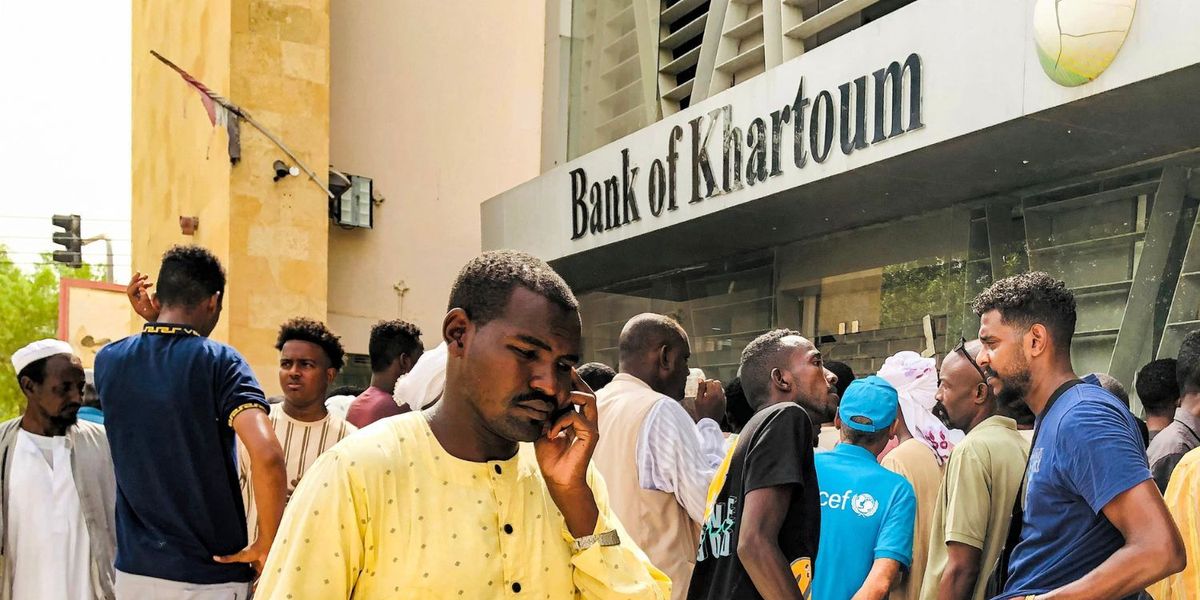
Dr. Mohamed Osman, an employee at the Bank of Sudan, described the exchange process as “highly inefficient and cumbersome.” He noted the extremely short timeline set for exchanging old currency for new, which led to overcrowded banks, severe cash shortages, and halted commercial activity. Images depicting long lines of frustrated citizens waiting outside banks for days became synonymous with this political decision.
The government’s realization that banks could not print enough new notes quickly enough left many citizens without any cash at all. Basic services were disrupted, as grocers, gas stations, and even rickshaw drivers stopped accepting the old currency. This crisis prompted an unexpected shift towards digital banking in Sudan, a country already ravaged by war.
The Government’s Strategy Behind the Currency Change
In light of the deteriorating economic conditions, the Sudanese government implemented a plan to bring cash back into the banking system, according to Dr. Osman. The objective was to reclaim funds that had been hoarded by the public since the era of the previous regime under Omar al-Bashir. The official narrative suggested that this currency change could potentially revitalize the economy.
However, many observers viewed this move as a political maneuver by the Sudanese Armed Forces (SAF), driven by a desire to regain control over financial flows amid ongoing conflicts with the Rapid Support Forces (RSF). The government’s plan also aimed to recover stolen funds that had been taken during bank lootings, particularly in Khartoum and Al Jazirah states. By issuing a new currency that could not be used in RSF-controlled areas, the SAF aimed to consolidate its economic dominance.
A Humanitarian Crisis and the Rise of Inflation
The ongoing war had already led to a humanitarian crisis, with widespread famine and skyrocketing inflation. The Sudanese pound, which was already trading at 500 to the US dollar prior to January, plummeted to around 3,000 by April 2023, showing little sign of stabilization despite the introduction of new banknotes. Almuthanna Abdulmoneim Alryeih Abdulgabbar, an electrical engineer from Port Sudan, poignantly stated, “The people of Sudan started a revolution against Omar al-Bashir because the price of bread was raised from 4 loaves for one pound to 2. Now they buy one loaf for 150 pounds.” This stark comparison highlights the severe economic hardships faced by citizens.
The Shift Towards Digital Banking
In areas controlled by the SAF, the reliance on bank apps for money transactions has become increasingly prevalent. Among the most widely used applications are the Bank of Khartoum’s “Bankak”, Faisal Islamic Bank’s “Fawry”, and Omdurman National Bank’s “Ocash”. Initially, these apps faced challenges, including poor accessibility and performance issues. As a result, once again, citizens found themselves queuing outside bank branches for hours just to activate their accounts.
Engineer Muhannad Hassan, a developer of the Ocash app, has attributed the problems to the banking systems rather than the apps’ design. “Obstacles for the user generally arise when the application system is updated,” he noted. “When the system is updating or down, people cannot make transactions or pay for necessities.” In a country already facing immense economic challenges due to war, such reliance on digital banking has left citizens in an even more precarious position.
A New Form of Trade Emerges
In this shifting currency landscape, a novel form of trade has surfaced: cash exchanges for balances transferred via applications. Abdulgabbar describes this practice, which can yield profits of up to 10,000 Sudanese pounds on a 100,000-pound transaction, as “nothing but plain usury,” which contradicts Islamic law, the major religion in Sudan.
While he acknowledges the merits of moving banking into the digital sphere, he criticizes the timing and reasoning behind the transformation, suggesting that the currency change served the interests of the military rather than the general population. Compatible opinions exist within the banking community; Osman’s perspective is more optimistic. He notes, “Despite the initial challenges, there has been a clear improvement in the transaction system since the initial period, making it easier for the public to open bank accounts.”
Conclusion
The unfolding situation in Sudan serves as a crucial case study for the global banking landscape amid conflict and crisis. While the introduction of digital banking offers a modern solution to an age-old problem, it also raises questions about accessibility, trust, and the political motives behind such radical changes. As Sudan navigates its way through this economic turmoil, the future of its currency and banking system remains uncertain, but the nation’s resilience continues to shine through the chaos.
Explore More:
Latest Bitcoin News |